 Susan Ann Walker, Fantasy Author
A Brief History of Shapeshifters
11/19/26 21:44 Filed in: Fantasy Facts
I've been thinking about shapeshifters lately.
That I spent most of the last year working on a book called The Rogue Shapeshifter couldn't have anything to do with that. Totally coincidental.
Also, I've been watching a series on the History Channel called The UnXplained, hosted by William Shatner, no less, doing his trademark over-the-top delivery with... all... these... PAUSES! Always fun to watch. Anyway, the last episode I saw was on vampires and werewolves, the most iconic shapeshifters of all.
I wondered, how far back does the shapeshifter trope go in literary history? So I did some research.
It turns out, pretty far! Shapeshifting appears in the oldest lore of totemism and shamanism, and in ancient stories and poems like the Epic of Gilgamesh and Homer's Iliad and Odyssey.
The concept of beings who shift into other forms is pretty much universal, although what they transform into varies by culture. Werewolves and vampires are mostly European, though they appear in Canadian and Native American stories as well. But India has legends of shapeshifting cobras; China has a shapeshifting fox spirit called huli jing; and Japan has creatures called obake and bakemono, names that literally translate into "thing that changes." And of course Norse mythology has Loki, the trickster god who's transformed into a mare, a salmon, a fly, and an elderly woman. Loki got around!
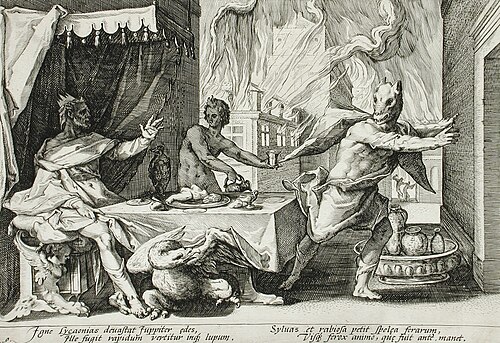
Greek and Roman myths are full of shapeshifters. Sometimes transformations were imposed as divine punishment: Zeus changed murderous King Lycaon and his children into wolves (which is where we get "lycanthropy"); Athena turned Arachne into a spider for weaving a blasphemous tapestry. Other times, the changes were beneficial: An old married couple, Baucis and Philemon, became intertwining trees when they died so they could stay together forever. This was a gift for being good hosts to the gods Jupiter and Mercury when they were traveling incognito (I'm lucky if my guests give me a cheap bottle of wine).
Fairy tales feature plenty of shapeshifting, too. Thanks to Disney, the best-known example (and my personal favorite) is Beauty and the Beast, with a handsome prince transformed into a hideous creature and then restored by the power of True Love. Or, as Peter Cook said it in The Princess Bride, "twue wove." The animated Disney film is from 1991, but the story is much older. It was published by a French novelist in 1740, but historians say the basic plot goes back around 4,000 years.
So, tales of shapeshifters have been with us a long time. Transformation is part of the human experience. Children grow into adults, and adults grow old and die. Strangers turn into friends and friends turn into strangers. Enemies become lovers and sometimes sadly vice versa. On a larger scale, empires rise and fall.
We're all shapeshifters. In one of my favorite movies, The Big Chill, William Hurt's character Nick says about returning from the Vietnam War: "I was evolving. I'm still evolving." As we evolve, and the world evolves around us, shapeshifter stories help us see that change doesn't always have to be bad, and it might even be something we can control.
Quick shameless plug: My take on the whole shapeshifter thing is The Rogue Shapeshifter: A Tale From the City of Magic. Check it out if you're so inclined.
Happy shifting, and never stop reading.


